
A product’s success hinges on a thoughtful design, especially in manufacturing. Design for Manufacturing(DFM) ensures that products are functional, affordable, and easy to manufacture. Even seasoned designers can slip up, leading to higher manufacturing costs, delays, or product flaws. Let’s examine frequent DFM mistakes and how to dodge them.
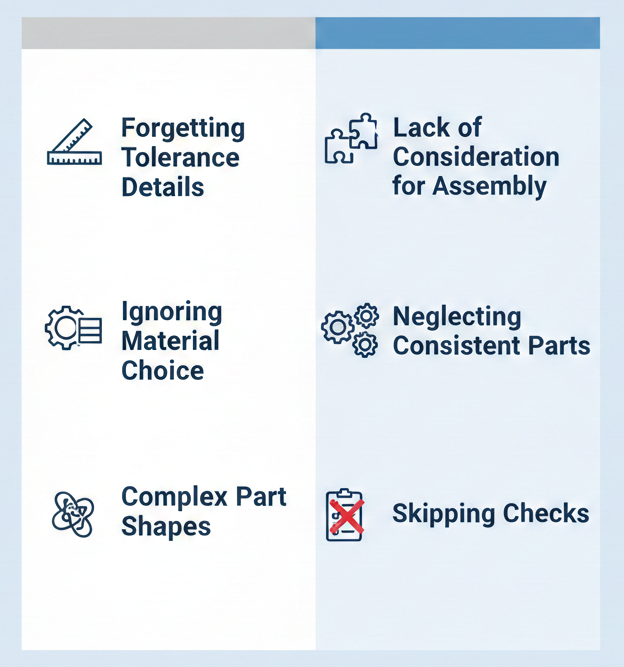
1. Forgetting Tolerance Details
Not setting precise tolerances is one of the common DFM mistakes. Tolerances define how much dimensions can change and ensure parts fit together correctly.
- Too strict tolerances can raise manufacturing costs and time.
- Overly loose tolerances can lead to product issues or assembly troubles.
Solution:
Set tolerances based on what you can actually make. Talk to your production team beforehand to ensure your design is feasible and reduce costly mistakes by regularly reviewing tolerances during design revisions.
2. Ignoring Material Choice
Picking the wrong material can cause production problems and long-term product issues. Designers sometimes place looks above manufacturability.
- Some materials are difficult to machine, which increases costs.
- Others might not handle the necessary stress or conditions.
Solution:
Consider machinability, strength, price, and availability when selecting materials. A good material choice can simplify manufacturing and cut production costs. To avoid compatibility issues, always verify material properties with suppliers.
3. Complex Part Shapes
Designers sometimes create overly complicated shapes that are hard to make. While these shapes might look great in CAD, they often cause production issues.
- Hard-to-machine features increase production time and costs.
- Complex designs require specialized tools that aren’t readily available.
Solution:
Make part shapes simpler when you can. Aim for designs that can be made with standard tools and methods without losing function. Go for modular designs that split complex parts into simpler sub-components.
4. Not Thinking About Assembly
A design isn’t done until it’s easy to put together. Forgetting assembly during design is one of the common DFM mistakes.
- Parts that are hard to line up or assemble can slow down production.
- Misaligned parts can cause functional issues in the final product.
Solution:
Add features that make assembly easier, like self-locating parts, standard fasteners, and symmetrical parts. Do a practice assembly or use computer models to spot potential issues early. To find practical improvements, always review assembly steps with operators.
5. Neglecting Consistent Parts
Using unique parts or features for each product might seem innovative, but it can cause unnecessary problems.
Here’s how using consistent parts affects manufacturing
| Aspect | Standardized Components | Custom Components |
|---|---|---|
| Cost | Low | High |
| Production Time | Short | Long |
| Quality | High | Variable |
| Ease of Assembly | Easy | Difficult |
Solution:
Use standard parts and fasteners whenever possible. Consistent parts lower production costs, reduce mistakes, and make assembly smoother. Keep a group of approved standard parts to simplify future designs.
6. Skipping Manufacturability Checks
Designers sometimes skip checking if something can be made, assuming that if it’s in CAD, it’s easy to produce. This can lead to pricey surprises during production.
Solution:
Conduct a Design for Manufacturing check to identify potential issues before production. Work with engineers and manufacturers to confirm that your design is practical, affordable, and easy to produce. To avoid new mistakes, keep updating the DFM error checklists for future projects.
Conclusion
In conclusion, avoiding common DFM mistakes is key to making products that are functional, affordable, and easy to manufacture. Designers can smooth out production and lower costs by focusing on tolerances, material choice, part shapes, assembly, and consistent parts. Doing a manufacturability review early in the design process means fewer changes, faster production, and better products. Following these tips will make your designs better and set your products up for success.
In addition, using DFM principles can make customers feel better about you. By creating solid, trustworthy products that meet or exceed customers’ expectations, companies can earn customers’ trust and loyalty. Happy customers are more likely to keep doing business with a company and to recommend it to others, which helps the company grow and succeed.
FAQs
Q1: What’s the main aim of Design for Manufacturing, or DFM?
DFM’s primary goal is to design products that are simple and cheap to make without cutting corners on quality or function.
Q2: How can I avoid tolerance issues in DFM?
Work closely with the manufacturing team to set realistic tolerances based on the production methods and capabilities.
Q3: Why is using consistent parts important in DFM?
Using consistent parts reduces costs, speeds up production, maintains consistent quality, and simplifies assembly.
Contact Us
📞 +91 99137 89065